Introduction
Voice analytics and audio evidence operations (AEO) form a growing pillar of decision making across security, compliance, and research domains. One critical challenge for analysts and engineers is to detect manipulation in voice AEO results to maintain integrity and avoid misleading conclusions.
This article presents nine practical methods to detect manipulation in voice AEO results, with step-by-step checks, examples, and mitigation guidance. Each entry explains the approach, offers a hands-on procedure, and compares trade-offs for real-world application.
1. Spectral Analysis and Visual Inspection
Overview
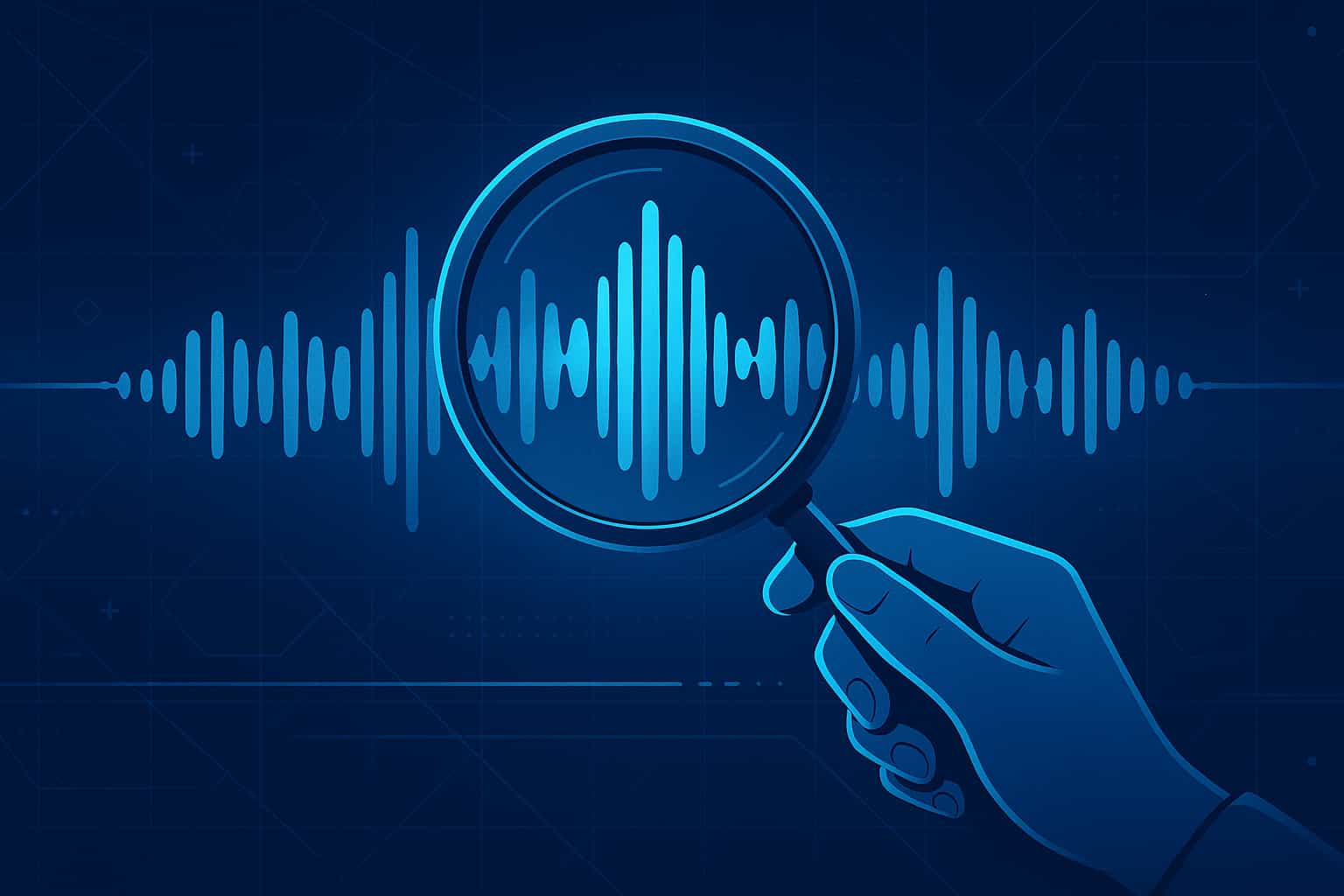
Spectral analysis reveals frequency content and time-varying features that are often altered during tampering. Analysts may detect abrupt discontinuities, unnatural harmonics, or missing noise floors that suggest edits or splices.
Step-by-step spectral check
First, generate a high-resolution spectrogram with a short-time Fourier transform and overlapping windows. Second, inspect for sudden changes in energy distribution, vertical lines that indicate cuts, and band-limited artifacts consistent with copy-paste edits.
Example and application
In a moderation case, an analyst compared spectrograms before and after alleged editing and found a sharp energy discontinuity at 7.2 seconds. That discontinuity matched a splice where a phrase from another recording had been inserted.
Pros and cons
- Pros: Intuitive visualization, effective for many manual audits.
- Cons: Requires expertise and may miss subtle deepfake artifacts concealed by processing.
2. Phase and Coherence Analysis
Overview
Phase relationships across channels and frequency bins indicate natural continuity in recorded audio. Manipulated segments often disrupt phase coherence or introduce unnatural phase patterns.
How to perform phase checks
Compute inter-channel phase differences and frequency-dependent coherence metrics. Flag segments with abrupt phase jumps or persistent low coherence while background conditions remain constant.
Case study
In a two-microphone surveillance capture, an investigator found a segment with low coherence yet normal amplitude. Further inspection revealed a re-synthesized voice overlay that lacked the room-derived phase characteristics present elsewhere.
Pros and cons
- Pros: Strong for multi-channel recordings and room acoustics validation.
- Cons: Less applicable to single-channel telephony or heavily compressed audio.
3. Noise Floor and Background Consistency Checks
Overview
Ambient noise is a fingerprint of recording context; inconsistencies indicate edits, transfers, or synthetic generation. Analysts must assess presence, spectral shape, and temporal stability of background noise.
Step-by-step background audit
Segment the recording into voiced and unvoiced regions and compute background noise spectra for each region. Compare spectra across segments and compute distance metrics such as Kullback-Leibler divergence to quantify deviation.
Real-world application
During a compliance review, a dataset exhibited mismatched ambient hiss between sentences. The inconsistency traced to an audio stitching process that omitted necessary room reverberation synthesis.
Pros and cons
- Pros: Effective when ambient conditions are stationary and predictable.
- Cons: Natural environment changes can produce false positives without contextual metadata.
4. Metadata and Provenance Verification
Overview
File headers, timestamps, and codec traces provide provenance signals that reveal editing history and toolchains. Verifying this metadata helps detect manipulation in voice AEO results early in an audit.
How to verify provenance
Extract container-level metadata, codec fingerprints, and any embedded digital signatures. Cross-reference creation times, modification timestamps, and tool identifiers with chain-of-custody records.
Example
An examiner discovered mismatched encoder signatures indicating that a purported original WAV had been transcoded from an MP3, suggesting prior lossy processing that could hide edits.
Pros and cons
- Pros: Fast and often decisive when metadata remains intact.
- Cons: Metadata can be forged or stripped; combine with content analysis for robustness.
5. Machine Learning Anomaly Detection
Overview
Unsupervised and supervised models can flag anomalies in acoustic features or representation spaces that human inspection might miss. These methods scale well for large AEO pipelines.
Implementation steps
Train autoencoders or one-class classifiers on trusted voice samples to learn normal patterns. Use reconstruction error or distance in embedding space to flag outliers and rank suspicious segments for review.
Case study and metrics
A forensic lab deployed an autoencoder trained on verified speech and achieved high recall for synthetic overlays, with manual review of the top 5 percent of flagged items reducing false positives substantially.
Pros and cons
- Pros: Scalable, sensitive to subtle deviations, and adaptable to domain specifics.
- Cons: Requires quality training data and careful threshold tuning to avoid overfitting.
6. Deepfake and TTS Detector Ensembles
Overview
Modern text-to-speech and voice conversion systems can produce convincing audio. Ensembles combining spectral, prosodic, and neural-detector signals improve detection of synthetic voices in AEO results.
Practical ensemble setup
Combine detectors focused on glottal excitation, prosody dynamics, and neural classifier outputs. Fuse scores with a lightweight calibration layer and produce ranked alerts for analyst review.
Example deployment
In a customer service fraud prevention system, ensembles reduced successful voice spoofing incidents by automating the initial triage while preserving human oversight for ambiguous cases.
Pros and cons
- Pros: Better resilience against adversarial synthetic methods when detectors complement each other.
- Cons: Computationally heavier and requires periodic retraining to track new deepfake techniques.
7. Linguistic and Prosodic Consistency Tests
Overview
Linguistic patterns and prosody carry subtle cues about speaker intent and continuity. Manipulation can produce unnatural pauses, inconsistent intonation, or improbable word transitions.
How to audit prosody and language
Analyze pitch contours, pause durations, and speech rate across segments and compare to baseline speaker models. Flag abrupt shifts in prosody that are not explained by context or emotion.
Application example
Investigators examining a political audio leak detected prosodic mismatch in a key sentence, which indicated that the sentence had been spliced from a different emotional context.
Pros and cons
- Pros: Effective for human-intelligible anomalies and cross-checking content-level edits.
- Cons: Cultural and language variability requires locally tuned models to reduce false positives.
8. Cross-Session and Cross-Device Correlation
Overview
Correlating features across multiple recordings, sessions, or devices helps detect inserted material that lacks consistent device characteristics. This method exploits hardware and channel fingerprints.
Procedure
Collect device fingerprints such as codec artifacts, microphone frequency response approximations, and clock drift patterns. Compare these fingerprints across segments to identify non-matching inserts.
Case study
A multi-session investigation revealed that a purportedly continuous call contained segments with differing device fingerprints, exposing a manipulated segment introduced from an external source.
Pros and cons
- Pros: High confidence when multiple reference recordings exist.
- Cons: Requires access to baseline sessions and may be limited by device heterogeneity.
9. Chain-of-Custody and Cryptographic Integrity Checks
Overview
Strong procedural controls and cryptographic signing preserve integrity and make manipulation detectable. Digital signatures, hashes, and secure storage dramatically reduce the attack surface.
Implementation steps
Implement immutable logs, compute SHA-2 hashes at ingest, and store signatures in a tamper-evident ledger. When discrepancies occur, verify hashes and timestamps to isolate altered artifacts.
Real-world benefits
Legal teams and compliance officers frequently prefer data with verified chains of custody because cryptographic evidence reduces disputes about authenticity during adjudication.
Pros and cons
- Pros: Strong prevention approach rather than detection after manipulation.
- Cons: Requires process discipline and infrastructure investment.
Conclusion
Detecting manipulation in voice AEO results requires a layered approach that combines signal analysis, machine learning, provenance checks, and strong process controls. No single method suffices for all scenarios, and effective practice combines complementary techniques to balance sensitivity and false-positive risk.
Practitioners should adopt clear validation pipelines, maintain high-quality reference data, and update detection methods as synthesis and editing technologies evolve. When applied together, the nine methods discussed provide a rigorous and practical framework to keep voice data trustworthy and defensible.