
How Does Programmatic SEO Work? A Step‑By‑Step How‑To Guide for Mastering Automated Search Rankings
Introduction
Programmatic SEO has become an essential tactic for sites that need to scale content and capture long‑tail search queries efficiently. This guide explains how does programmatic SEO work? and provides actionable steps, technical details, and real‑world examples. The reader will learn how data, templates, automation, and monitoring combine to create large volumes of useful, discoverable pages. The approach is practical and oriented toward sustainable search performance.
What Is Programmatic SEO?
Definition and Objectives
Programmatic SEO is the process of using structured data, templates, and automation to generate many search‑optimized pages based on predictable patterns. The objective is to capture search demand at scale for queries that share common intent but differ by variables such as location, product, or attribute. This method leverages data to produce relevant, indexable content while reducing manual effort. It is distinct from manual content production in its reliance on repeatable templates and programmatic logic.
When to Use Programmatic SEO
Programmatic SEO is most effective when there exists a structured universe of items amenable to templated pages, such as products, services by city, or categorized resources. The approach works well for marketplaces, directories, travel sites, real estate listings, job boards, and pricing aggregators. One should prefer programmatic methods when the dataset is large, stable, and aligned with clear user intent patterns. It is not ideal when queries require bespoke storytelling or highly subjective analysis.
How Does Programmatic SEO Work?
Core Components
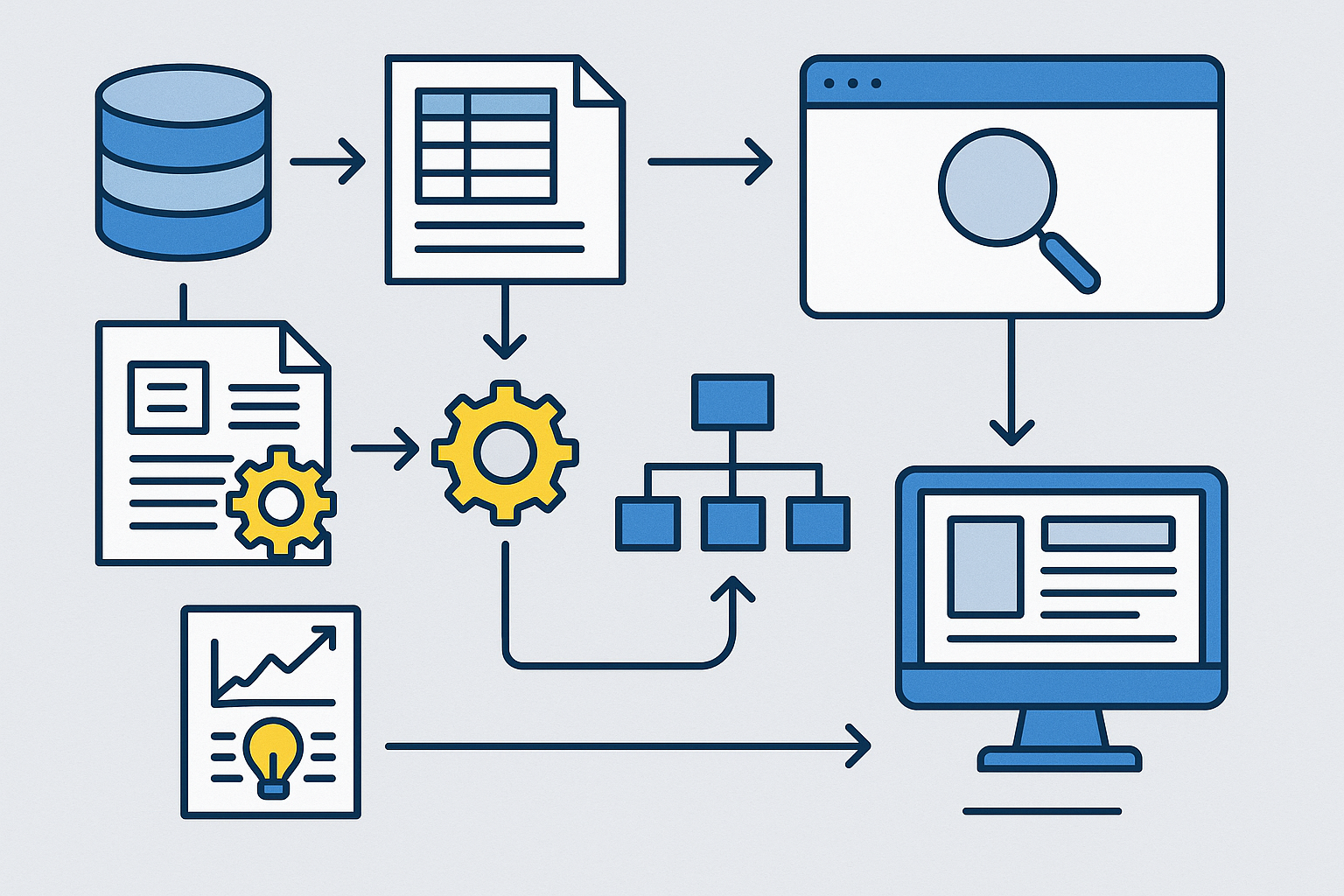
The core components are data collection, template design, automated content generation, on‑page SEO, and monitoring. Each component must be designed to support discoverability, relevance, and quality at scale. Automation orchestrates these components to convert raw data into search‑friendly pages rapidly. The remainder of this section breaks down each component and describes operational details.
Data Collection and Structure
Programmatic SEO begins with structured data that represents the domain universe one intends to cover. This can include product specifications, geographic attributes, event dates, or business listings, and it is typically stored in CSV, database, or API format. The quality of the dataset determines the utility and accuracy of generated pages, so data validation and enrichment are essential steps. Common techniques include deduplication, normalization, and canonical identifier assignment.
Template Creation and Content Design
Templates serve as the skeleton for every generated page, translating variables from the dataset into headings, meta tags, and descriptive sections. Good templates incorporate semantic HTML, schema.org structured data, and dynamic sections that adjust to the richness of the dataset. Designers should include both static explanatory copy and dynamically filled elements that provide value for each variant. Templates must also account for editorial controls to avoid thin or repetitive content.
Automated Content Generation
Automation tools populate templates with dataset variables to create pages programmatically. This process can be executed via scripting languages, content management system (CMS) APIs, or a static site generator fed by a data pipeline. Where personalization or unique descriptions are required, programmatic templates can incorporate modular content blocks with conditional logic. It is prudent to include fallbacks for missing data so pages remain coherent and user friendly.
Indexing, On‑Page SEO, and Technical Signals
Programmatic pages must be indexable and present clear signals to search engines, including descriptive title tags, meta descriptions, header structure, and internal links. Site architecture should enable crawlers to discover generated pages through sitemaps, paginated indexes, and category hubs. Technical considerations include canonical tags to prevent duplicate content, robots directives for non‑valuable variants, and proper use of hreflang where language or region variants exist. Fast performance and mobile friendliness remain key ranking signals.
Internal Linking and Site Architecture
Internal linking supports crawl efficiency and distributes authority to programmatic pages from high‑value hub pages. Category pages, index pages, and breadcrumb trails help both users and search engines understand relationships between generated pages. One recommended practice is to design a layered taxonomy where broad hubs link to more specific programmatic pages, preserving logical discoverability. Pagination and facet handling require explicit decisions to avoid crawler traps and dilution of link equity.
Monitoring, Quality Assurance, and Iteration
Monitoring performance via analytics and search console data is essential to validate the impact of programmatic pages. Key metrics include organic impressions, clicks, average position, bounce rate, and user engagement signals. Quality assurance should incorporate sampling for content accuracy, mechanical checks for broken links, and automated audits for SEO compliance. Iteration involves refining templates, data enrichment, and selective pruning of underperforming variants.
Step‑By‑Step How‑To Guide
1. Plan and Research
Begin with keyword research to identify scalable search intents that map to dataset variables. One should prioritize clusters of long‑tail queries that share intent but vary by attribute, such as ‘‘best plumber in [city]’’ or ‘‘flights from [airport] to [destination]’’. Next, estimate potential search volume and competitive landscape to justify building programmatic pages. A documented taxonomy and list of variables will streamline downstream steps.
2. Build the Data Pipeline
Assemble a reliable data source and design a pipeline to import, clean, and normalize records into a canonical dataset. Automate enrichment steps, such as adding geocodes, category mappings, or price feeds, to increase page utility. Ensure version control and rollback procedures in case of corrupted imports. For dynamic markets, schedule regular refresh cycles to synchronize content with live data.
3. Design Templates and CMS Integration
Create modular templates that render variables into SEO‑ready elements, including title, H1, meta description, schema markup, and body copy. Integrate the template engine with the selected CMS or static generator, ensuring it can accept bulk input via API or file ingest. Implement editorial override fields for manual enhancements and for legal or brand compliance. Test templates across multiple dataset variations to identify edge cases.
4. Generate Pages and Manage Indexing
Generate pages in a controlled environment, validate HTML, and create sitemaps segmented by priority or freshness. Use robots.txt and meta robots pragmatically to exclude low‑value parameterized pages. Submit sitemaps to search consoles and monitor indexing behavior to confirm desired pages are crawled and indexed. For very large outputs, stage releases to avoid overwhelming crawl budgets.
5. Quality Assurance and Launch
Perform a prelaunch QA checklist that includes schema validation, canonical correctness, meta tag uniqueness, and page speed testing. Conduct a sample content review for factual accuracy and readability to maintain user trust. Once QA metrics are satisfactory, deploy the pages and monitor server load during the initial indexing period. Maintain a rollback plan to disable pages quickly if issues arise.
6. Monitor, Prune, and Iterate
After launch, track performance data to identify high‑value pages and underperformers. Prune or consolidate pages that attract negligible traffic and drain crawl budget or cause duplicate content issues. Iterate templates by adding richer content modules, FAQs, or UGC to improve engagement. Continuous testing and refinement enable programmatic SEO to adapt to algorithmic and market changes.
Technical Implementation Details
Example Tech Stack
A typical tech stack includes a data store (PostgreSQL or BigQuery), ETL scripts (Python, Airflow), a template engine (Jinja, Liquid), a CMS or static generator (WordPress with headless API, Next.js, Hugo), and monitoring tools (Google Search Console, GA4, Datadog). The choice of stack depends on expected scale, developer resources, and latency requirements. For extremely large catalogs, static generation with incremental builds often yields better performance and lower hosting cost.
SEO Considerations: Canonicals and Crawl Budget
Programmatic pages frequently create near‑duplicates that require careful canonicalization. Use canonical tags to point to the preferred variant and avoid indexing thin variants. For facets and filter combinations, consider noindex or parameter handling to preserve crawl budget. Also, implement paginated rel links where necessary and ensure sitemaps expose only primary URLs.
Case Studies and Real‑World Examples
Example 1: Local Service Marketplace
A home services marketplace built programmatic pages for ‘‘[service] in [city]’’ queries using a dataset of 50,000 service‑city combinations. Templates included service descriptions, localized FAQs, provider listings, and review snippets. After three months, organic impressions for long‑tail local queries increased by 320 percent, with conversion‑rate improvements driven by tailored local content. The company pruned low‑traffic city pages to optimize crawl budget.
Example 2: Travel Fare Aggregator
A travel aggregator generated landing pages for common routes using historical fare patterns and airport metadata. Pages demonstrated typical prices, best booking windows, and top airlines for each route. Programmatic pages captured demand for niche routes that previously had no organic landing pages, boosting organic bookings by 18 percent. The team used structured data for flights to enhance rich results and improve click‑through rates.
Pros and Cons
Programmatic SEO offers high scalability and cost efficiency when a project has repeatable content needs and structured data. Benefits include rapid coverage of long‑tail queries, improved discoverability, and the ability to target niche search intents. Drawbacks include the risk of thin or duplicate content, potential indexing challenges, and the need for continuous data hygiene and monitoring. Organizations must weigh maintenance overhead against potential traffic gains.
Common Pitfalls and How to Avoid Them
Common pitfalls include publishing low‑value variants, poor template design that yields duplicate content, and neglecting canonical tags. To avoid these issues, implement editorial rules, enrich templates with unique useful content, and create rules for which variants are allowed to index. Also, monitor search console warnings and conduct periodic audits to catch crawl anomalies early. A governance plan for data and templates reduces long‑term risk.
Programmatic SEO Compared to Alternatives
Programmatic vs Traditional SEO
Traditional SEO often focuses on handcrafted cornerstone content and targeted landing pages requiring manual writing and optimization. Programmatic SEO emphasizes breadth over bespoke depth and uses automation to capture large volumes of repetitive intents. A balanced strategy typically combines both methods to serve both informational hubs and scale‑driven needs. Organizations must align strategy with business model and resource availability.
Programmatic vs Content Automation
Content automation tools produce variations of human content but may not integrate structured data and template logic at the architectural level. Programmatic SEO includes architectural decisions about indexing, canonicalization, and taxonomy that content automation alone does not address. The two approaches can coexist when automation supplies modular copy that programmatic templates assemble. Quality controls are essential in both cases.
Conclusion
Programmatic SEO can be a decisive advantage for organizations that need to target large sets of related search queries efficiently. Understanding how does programmatic SEO work? involves mastering data pipelines, template design, indexing strategy, and ongoing monitoring to ensure pages deliver value. When executed thoughtfully, programmatic pages drive sustainable organic growth by capturing long‑tail intent with relevant, discoverable content. The key to success remains quality data, robust templates, and continuous iteration based on performance metrics.