
How to Calculate Bulk Article Generation Pricing: A Step‑by‑Step Cost‑Saving Guide
Bulk article generation pricing determines the economics of large content projects and guides decisions for both buyers and providers. This guide explains cost components, pricing models, step-by-step calculations, and negotiation tactics to reduce cost while preserving quality. It contains examples, two case studies, and practical spreadsheets one can implement immediately.
Introduction: Why Pricing Matters for Bulk Article Projects
Bulk article generation pricing sets expectations for budgets, timelines, and returns on content investment. Organizations that plan for all cost drivers avoid unpleasant surprises and obtain predictable outcomes. The remainder of the article details methods to calculate realistic pricing and achieve measurable cost savings.
Key Cost Components to Account For
Research and Brief Development
Research establishes topical authority, keyword targets, and competitive frameworks before writing commences. Teams typically allocate time to source references, create outlines, and prepare client briefs or templates. Pricing must incorporate hourly rates for research or a fixed per-article research fee, depending on volume and complexity.
Writing and Content Creation
Writing is the core expense and may be charged per word, per article, or per hour depending on the provider model. Complexity, technical depth, and required expertise materially increase the rate per word or per project. When calculating costs, the provider should estimate time-to-complete and multiply by the writer hourly rate, or apply a per-word benchmark for large-scale work.
Editing, Fact‑Checking, and Quality Assurance
Editing secures coherence, accuracy, and style adherence, and often includes fact-checking and compliance reviews. Quality assurance may require one or more rounds of editorial passes, which raises the per-article cost. Providers must estimate copyediting hours, plus a buffer for rounds of revisions, and then include those items in the overall unit cost.
SEO Optimization and Metadata
Search engine optimization (SEO) adds keyword research, meta titles, descriptions, schema, and on-page optimization to each article. This work can be automated partially with tools or handled manually by an SEO specialist. Pricing must reflect whether SEO is included in base content fees or billed as an optional add-on service.
Images, Multimedia, and Licensing
Images and multimedia enhance engagement but introduce licensing, acquisition, and editing expenses. Stock photography, custom graphics, and video thumbnails each have individual costs and may be purchased at scale discounts. The provider should decide whether to bundle multimedia with articles or charge per asset to maintain transparent margins.
Project Management and Communication
Project management coordinates writers, editors, and client stakeholders, and therefore consumes time and resources. For large batches, a dedicated project manager often becomes necessary to maintain cadence and quality. Project management costs should be amortized across the batch and included in per-article pricing to avoid undercharging.
Technology, Tools, and Platform Costs
Tools for SEO research, plagiarism checking, content brief creation, and editorial workflows carry subscription fees that contribute to unit costs. Providers commonly allocate tool costs across projects by dividing monthly subscriptions by expected article volume. Transparent quoting will show whether tools are included or billed separately.
Revisions, Rush Fees, and Contingencies
Revisions and rushed delivery windows create variability in cost and must be planned for with policy and pricing. A typical bulk contract will include a fixed number of revision rounds and a per-round rate thereafter, plus defined rush fees for compressed schedules. Contingency allowances of 5 to 15 percent of the budget protect providers from scope creep and unexpected delays.
Common Pricing Models for Bulk Article Generation
Per‑Word Pricing
Per-word pricing is simple and scales neatly with length, commonly used for straightforward content and predictable editorial tasks. Rates vary by expertise and market, from commodity-level cents-per-word to specialist dollars-per-word. Advantages include easy comparisons; disadvantages include potential under-incentives for depth and research.
Per‑Article Pricing
Per-article pricing attaches a fixed fee to each piece regardless of minor length variations, and works well for templated content. This model simplifies billing for clients and stabilizes revenue for providers. A clear article definition must state word ranges, deliverables, and included services to avoid disputes.
Subscription or Retainer Models
Subscription models provide a steady monthly fee for a set number of articles, useful for ongoing content programs and predictable cash flow. They encourage long-term relationships and often include discounts compared to ad-hoc pricing. The trade-off is less flexibility for fluctuating monthly demands unless the retainer allows rollovers or add-on options.
Tiered and Volume Discount Models
Tiered pricing assigns price breaks based on thresholds, for example 1-50 articles, 51-200 articles, and 201+ articles. Volume discounts reward larger commitments and improve unit economics for both parties. Contracts should clearly capture tier boundaries, renewal terms, and discount applicability to avoid ambiguity.
Hybrid and Performance‑Based Models
Hybrid models combine base fees with bonuses tied to performance metrics such as traffic, conversions, or rankings. Performance-based pricing aligns incentives but requires robust analytics and pre-agreed KPIs. Measurement windows and attribution must be precise to avoid disputes about earned bonuses.
Step‑by‑Step Calculation Guide
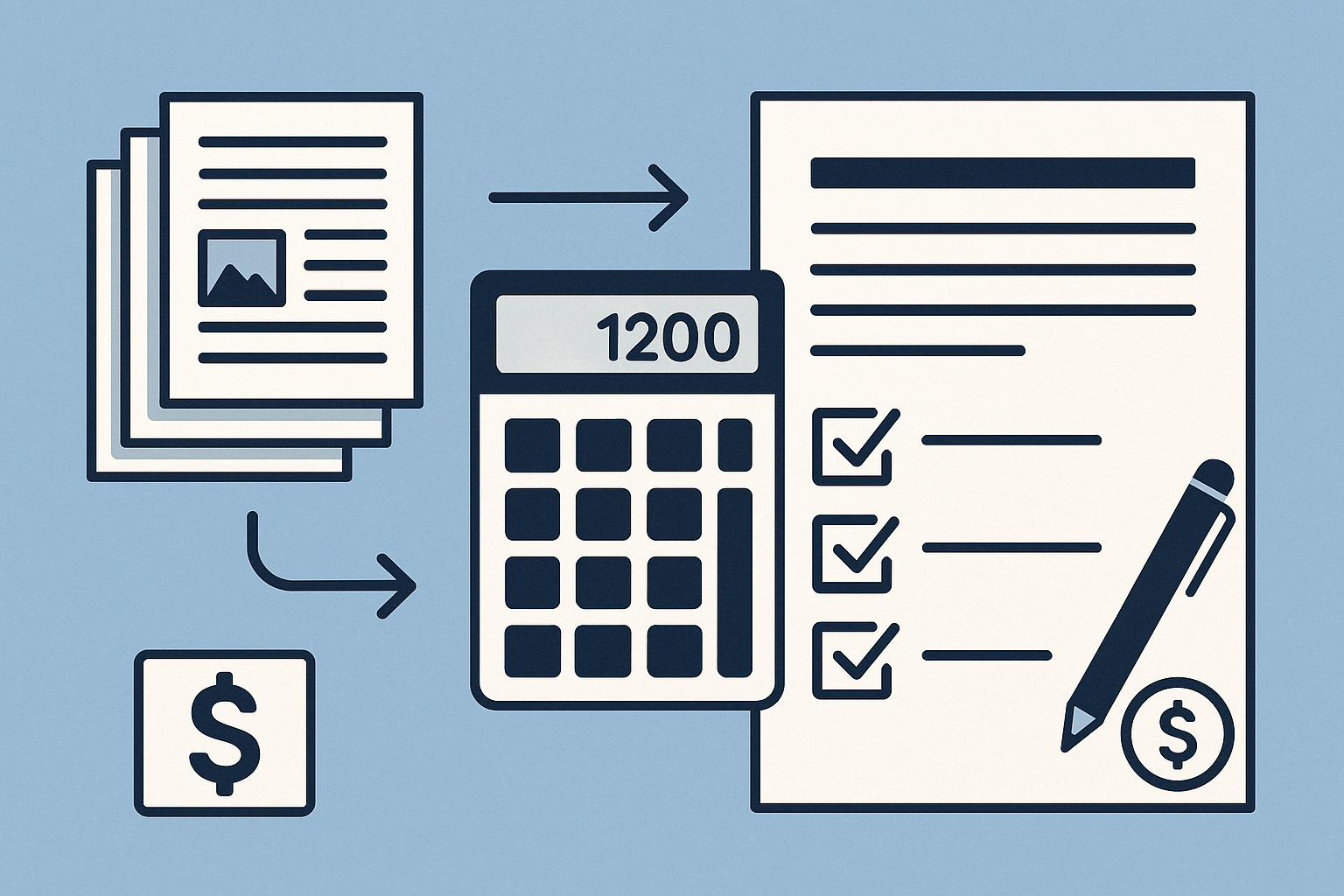
This section provides a reproducible method to calculate bulk article generation pricing with an example. The method begins with cost components, then adds desired margin and applies discounts for volume.
Step 1: Define the Scope and Standards
Specify word count ranges, deliverables, SEO depth, image counts, and turnaround expectations for each article. Establish acceptable quality metrics and the number of included revision rounds. The scope will drive time estimates and clarify which cost elements are mandatory versus optional.
Step 2: Estimate Time and Rates by Role
List roles required per article such as researcher, writer, editor, SEO specialist, and PM, and estimate hourly time for each role. Assign an hourly rate per role and compute role cost as hours times rate. Sum role costs to obtain a base labor cost per article.
Step 3: Add Tool, Asset, and Overhead Costs
Divide monthly tool subscriptions, stock image purchases, and overhead by expected monthly article output to derive per-article allocations. Include hosting or CMS publishing fees if applicable. Add a contingency percentage for unexpected costs, typically between five and fifteen percent.
Step 4: Apply Margin and Finalize Retail Price
Select a profit margin that reflects risk, brand, and market positioning, commonly between 15 and 40 percent for agencies. Multiply the total cost per article by 1 plus the margin percentage to set the client-facing price. For bulk jobs, determine volume-based discounts from the retail price while preserving the desired margin.
Example Calculation: 100 Articles, 800 Words Each
Assume roles and time per article: research 0.5 hours, writing 2.0 hours, editing 0.75 hours, SEO 0.5 hours, PM 0.25 hours. Assume hourly rates: researcher $35, writer $50, editor $45, SEO $60, PM $40. Calculate role costs: researcher $17.50, writer $100.00, editor $33.75, SEO $30.00, PM $10.00, summing to $191.25 labor per article.
Allocate tools and assets at $10 per article and overhead at $8 per article, producing a subtotal cost of $209.25. Add contingency of 7 percent ($14.65) to reach $223.90 cost per article. Apply a 25 percent margin to set a retail price of $279.88 per article, and for a 100-article commitment provide a 15 percent volume discount to yield $237.90 per article as a negotiated bulk rate.
The batch cost for 100 articles at the negotiated rate equals $23,790, while the provider retains approximately $8,590 in gross margin after labor and overhead, assuming the estimated times are accurate. These numbers illustrate how time efficiencies and automation improve the provider margin and permit more aggressive discounts.
Comparisons: Freelancers Versus Agencies Versus AI‑Assisted Workflows
Freelancers typically offer lower per-unit rates but variable consistency, making them suitable for moderate volumes and flexible workflows. Agencies supply processes, project management, and quality guarantees at higher cost, which scale well for enterprise needs. AI-assisted workflows reduce human labor with tools that generate first drafts, thereby lowering per-article labor time but requiring human editing to protect quality.
Case Studies and Real‑World Applications
Case Study A: E‑Commerce Brand — 50 Articles for Seasonal Launch
An e-commerce brand contracted 50 product-category articles to support a seasonal launch and accepted a per-article price inclusive of SEO and images. The provider used templates, a single researcher, and two writers to maintain throughput and delivered in four weeks. The campaign increased category organic traffic by 18 percent within three months, and the brand calculated an estimated return on ad spend that justified the content investment.
Case Study B: Enterprise Content Program — 500 Articles Over 12 Months
An enterprise group required 500 in-depth guides and selected a subscription model with tiered pricing and performance bonuses tied to search rankings. The provider combined AI-assisted drafting, subject-matter expert reviews, and rigorous SEO workflows to control costs. The program achieved scale efficiencies and reduced the average per-article cost by approximately 28 percent compared to initial per-article quotes.
Negotiation, Packaging, and Contract Tips
Buyers should request clear line-item pricing and defined SLAs for turnaround, revisions, and quality metrics prior to committing. Providers should offer tiered packages with explicit deliverables and sample articles to set expectations. Both parties should document acceptance criteria, payment terms, cancellation clauses, and ownership of intellectual property in the agreement.
Tools, Templates, and Calculator Recommendations
Providers often create a pricing calculator in Google Sheets or Excel using the step-by-step cost model previously described. Recommended fields include role hours, hourly rates, tool allocations, overhead, contingency, margin, and discount thresholds. Analytics and SEO tools such as keyword planners, content brief generators, and plagiarism checkers support both pricing accuracy and quality assurance.
Pros and Cons Summary
Per-word and per-article pricing models offer simplicity but require tight definitions to avoid disputes. Subscription and tiered models support scale and predictability while demanding accurate forecasting of demand and capacity. Performance-based pricing aligns incentives strongly but hinges on clear, measurable KPIs and reliable attribution.
Conclusion
Calculating bulk article generation pricing requires a systematic approach that accounts for all labor, tools, overhead, and contingency. By following the step-by-step method and using transparent models providers and buyers can negotiate fair rates that preserve quality and deliver cost savings. The examples and case studies presented provide a foundation one can adapt to specific markets, volumes, and quality expectations.