
How to Master Programmatic SEO for Affiliate Sites: A Step‑by‑Step Guide to Automated Traffic Growth
Introduction
Programmatic SEO for affiliate sites is a powerful methodology for scaling organic traffic through automated page creation and data-driven content. The approach combines structured data, templated content, and automation pipelines to target long-tail keywords at scale.
This guide explains practical steps, technical setup, content design, measurement, and risk mitigation for programmatic SEO on affiliate sites. It aims to equip the practitioner with an actionable framework suitable for medium and large affiliate portfolios.
What Is Programmatic SEO and Why It Matters
Definition and core concept
Programmatic SEO is the practice of generating many search-optimized pages automatically from a data source and consistent templates. The pages are intended to rank for long-tail queries and variant search intents that would be impractical to cover manually.
Why affiliate sites benefit
Affiliate sites frequently have large product inventories and many attribute combinations that match user queries. Programmatic SEO for affiliate sites enables rapid coverage of those combinations, increasing the probability of capturing organic traffic and conversions.
Pros and Cons of Programmatic SEO for Affiliate Sites
Pros
- Scalability: the site owner can produce thousands of pages from a single data model with minimal manual effort.
- Coverage: programmatic pages capture long-tail and niche queries that deliver qualified traffic for affiliate conversion.
- Speed: new product launches and data updates propagate quickly across the site via automation.
Cons and risks
- Thin content risk: templated pages can be low value if they lack unique, useful content beyond basic attributes.
- Crawl budget and index bloat: generating too many low-value pages can waste crawl budget and harm indexation quality.
- Maintenance complexity: automated systems require robust pipelines, monitoring, and error handling to avoid large-scale issues.
Preparing for a Programmatic Build
Define clear business goals and KPIs
One should specify the outcomes desired from programmatic SEO, such as organic traffic, affiliate conversions, or revenue per page. Relevant KPIs include clicks from search, conversion rate, average order value and pages indexed in Google Search Console.
Choose the right use cases
Not every topic suits programmatic scale. The practitioner selects candidates where data is structured and user intent is consistent, such as product pages, comparison matrices, regional service pages, or compatibility lookup pages.
Data Strategy: Sources, Modeling, and Quality
Primary data sources
High-quality structured data is the foundation of programmatic SEO for affiliate sites. Common sources include merchant APIs, product feeds, public datasets, manufacturer specifications, and internal databases.
Modeling the data
One must design a data model that maps reliably to SEO variables such as title, H1, meta description, features list, specifications and price. The model also defines filters and facets used to create unique page permutations.
Quality control
Data validation rules prevent garbage pages. Example checks include ensuring non-empty titles, valid image URLs, price ranges, and deduplication of identical SKUs. Automated tests should flag anomalies before pages publish.
Content Templates and On-Page Design
Template anatomy
Templates should combine dynamic placeholders with static explanatory content to create contextually useful pages. Core elements are optimized title tags, H1s, concise meta descriptions, a descriptive introduction, key features, comparison tables and call to action elements.
Creating useful, unique content
To avoid thin content, supplement templated sections with unique copy, long-form contextual paragraphs, user reviews, aggregated ratings, or Q&A that address specific search intent. One effective tactic is to include dynamic user intent snippets generated from query logs.
Schema and structured data
Implement relevant structured data such as Product, Offer, AggregateRating and FAQ schema to increase the chance of rich results. Proper schema increases visibility and supports feature eligibility that can improve click-through rates.
Technical Implementation and Automation Pipeline
Architecture choices
There are two main architectures: pre-rendered static pages generated by a build pipeline and dynamic server-rendered pages generated on demand. Each method has trade-offs in hosting cost, latency and freshness of data.
Build pipeline example
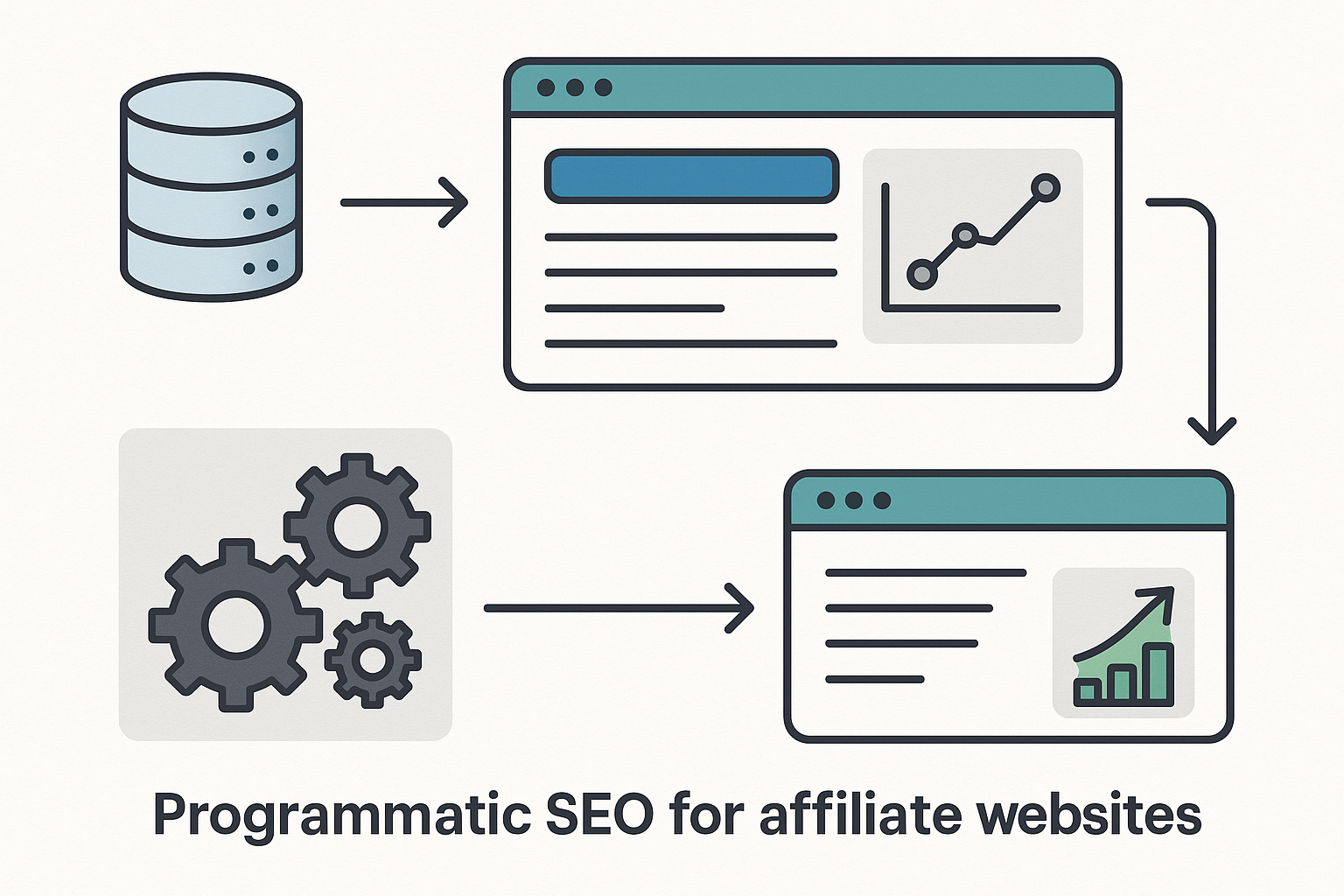
- Ingest data from merchant API into a canonical data store such as PostgreSQL or Airtable.
- Run validation and deduplication scripts implemented in Python or Node.js.
- Render pages via a static site generator or headless CMS export that merges templates with data.
- Deploy pages to a CDN with automated sitemap updates and Search Console indexing requests for high-priority sets.
On-demand rendering example
For very large catalogs, server-side rendering combined with aggressive caching allows pages to render dynamically while saving storage. One must implement cache invalidation to reflect price and stock changes promptly.
SEO Technical Best Practices
URL structure and canonicalization
Design logical, keyword-friendly URL patterns that represent the data attributes, such as /category/brand-model-feature/. Use canonical tags to consolidate similar pages or signal the preferred version when attribute combinations overlap.
Sitemap and crawl management
Generate sitemaps that prioritize high-value pages and exclude pages that are unlikely to rank or convert. Use robots.txt and meta robots directives to prevent indexing of duplicate or experimental page sets.
Pagination, facets, and parameter handling
Faceted navigation can generate combinatorial explosions of URLs. One should use rel="next/prev" where appropriate and instruct search engines via parameter handling to ignore or follow specific combinations. Consider view-all pages for indexing priority.
Link Building and Promotion Strategies
Internal linking and hub pages
Programmatic pages must be discoverable via meaningful internal links from category hubs, comparison pages, or editorial content. A well-structured internal linking strategy distributes PageRank to long-tail pages effectively.
External promotion tactics
For priority segments, the practitioner may run targeted outreach, syndication, or paid campaigns to seed links and traffic. Press coverage for curated best-of lists and data-driven studies can attract natural backlinks to programmatic clusters.
Measurement, Testing, and Iteration
Key metrics and tools
Use Google Search Console, GA4, server logs, and rank-tracking tools to monitor indexation, impressions, clicks, and conversions. Log file analysis helps identify crawl frequency, bot behavior, and orphan pages that require attention.
A-B testing and experiments
One can A-B test template variants, metadata formulations, and user interface elements to determine which patterns improve click-through and conversion rates. Employ controlled experiments and statistical tests to validate improvements.
Step-by-Step Implementation Checklist
- Define objectives and KPIs specifically for affiliate conversion and organic traffic growth.
- Select high-potential use cases with structured data and clear search intent.
- Assemble and validate data sources with automated quality checks.
- Design SEO-first templates that include dynamic and unique sections.
- Implement structured data and on-page technical SEO elements.
- Build an automation pipeline for rendering, testing and deployment.
- Launch a prioritized sitemap and internal linking rollout plan.
- Monitor performance using GSC, GA4, and log analysis, then iterate.
Case Study: GadgetFinder Affiliate Cluster
GadgetFinder, a hypothetical affiliate for consumer electronics, created 10,000 pages by combining brand, model, region and accessory compatibility attributes. The team ingested manufacturer feeds and user-generated compatibility reports into a central dataset.
The template included a comparison table, unique model summary, compatibility insights and localized pricing pulled from APIs. After launch, the cluster delivered a 40 percent increase in long-tail impressions and a measurable uplift in affiliate revenue for targeted categories.
Key success factors included rigorous data validation, a prioritized sitemap, and staged rollout with continuous A-B testing of meta titles and calls to action. The project demonstrates how programmatic SEO for affiliate sites delivers scalable benefits when quality controls are enforced.
Common Pitfalls and How to Avoid Them
Pitfall: too many low-value pages
One must avoid indiscriminate page generation. The practitioner should define quality thresholds and noindex rules for pages that do not meet traffic or conversion potential.
Pitfall: duplicate content and cannibalization
Canonical tags, template variation, and clustering related pages by hub can prevent internal competition. Strategic canonicalization reduces cannibalization while preserving user access to useful variants.
Final Recommendations and Next Steps
Programmatic SEO for affiliate sites is most effective when treated as a productized discipline that combines data engineering, SEO strategy and content design. The practitioner should invest in automation, continuous monitoring and small-scale experiments before broad scaling.
One should start with a pilot of a few hundred pages, validate search performance, and expand using documented playbooks and monitoring. With proper controls, programmatic SEO can deliver sustained, scalable organic growth for affiliate sites.
Conclusion
Mastering programmatic SEO for affiliate sites requires a blend of structured data, thoughtful templates, robust automation and ongoing measurement. When executed with quality controls, the method unlocks significant long-tail traffic and conversion opportunities at scale.
Site owners and practitioners that follow the step-by-step framework and prioritize page quality can achieve automated traffic growth while minimizing the common risks associated with large-scale page generation.