How to Orchestrate Fan-Out Queries in a RAG Pipeline: Step-by-Step Guide to Efficient Parallel Retrieval and Aggregation
This guide explains orchestrating fan-out queries RAG pipeline strategies for efficient parallel retrieval and aggregation in production systems. It addresses design patterns, tradeoffs, and practical implementation steps for developers and architects. The reader will find examples, case studies, and concrete code-agnostic patterns that support robust, observable systems.
Introduction: Why Fan-Out Matters in RAG Pipelines
Retrieval-Augmented Generation pipelines combine retrieval of documents or vectors with generative models to produce informed, accurate responses. Fan-out queries are the practice of issuing multiple retrieval requests in parallel to cover different data sources, modalities, or retrieval strategies. Orchestrating fan-out queries in a RAG pipeline unlocks higher recall and topic coverage while requiring attention to latency, consistency, and cost.
One must balance parallelism with complexity and resource constraints. This article provides a step-by-step plan to design, implement, and operate fan-out retrieval patterns for RAG systems in production environments.
Core Concepts and Terminology
What is Fan-Out Retrieval
Fan-out retrieval performs multiple concurrent queries across separate indexes, vector stores, or knowledge sources in order to gather complementary results. It differs from sequential retrieval by investing in parallel work to reduce total response time while increasing the variety of results. Practitioners use fan-out to query topic-specific indexes, cross-lingual stores, or different embedding models simultaneously.
RAG Pipeline Overview
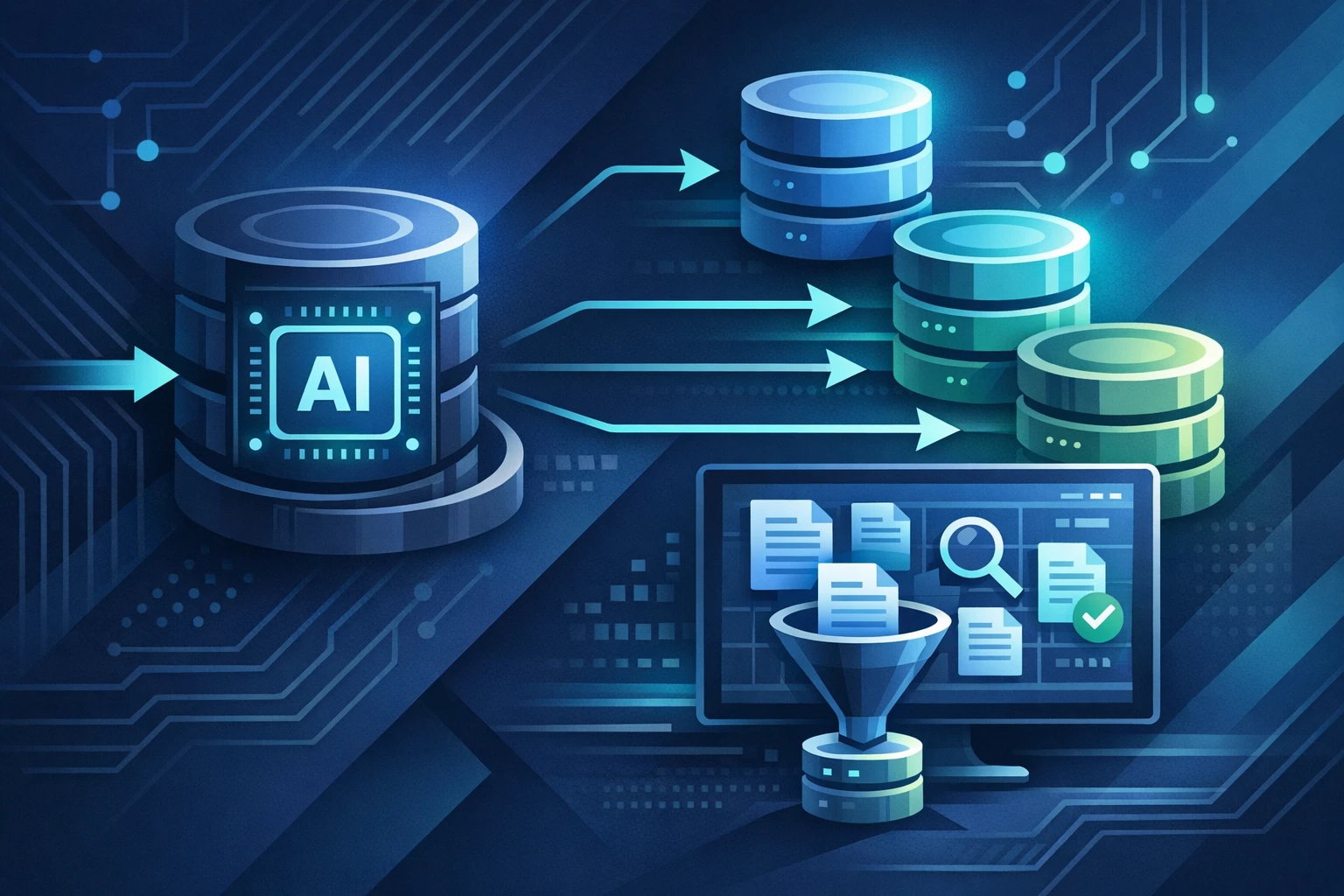
A typical RAG pipeline contains stages for query processing, retrieval, aggregation, reranking, and generation. The retrieval stage may itself contain multiple parallel branches that constitute the fan-out. Aggregation merges the outputs into a coherent set that the generator consumes. Each stage must preserve provenance and support observability for debugging and evaluation.
Step-by-Step Orchestration Guide
Step 1: Define Retrieval Objectives and Sources
Begin by defining what the retrieval outcomes must achieve in terms of recall, precision, latency, and coverage. List the knowledge sources that matter for the application, such as internal documents, external APIs, embeddings from different models, structured databases, and multimedia stores. Prioritize sources that complement each other to maximize value from the fan-out strategy.
For example, a support assistant might query a product FAQ index, a troubleshooting database, and a recent ticket embeddings store concurrently to cover canonical answers and recent incidents. This approach reduces missed answers while bounding latency with parallel execution.
Step 2: Choose Retrieval Engines and Embedding Models
Select vector stores and search engines tuned to each source and workload. Use embedding models that align to the data modality and query intent, and consider mixing dense vector search with sparse lexical search for complementary behavior. Document the expected quality and cost for each engine to inform orchestration decisions.
An example mix includes a high-precision lexical index for exact matches, a domain-specific dense index for concept matches, and a real-time cache for very recent documents. Combining these helps cover immediate recalls and semantic matches simultaneously.
Step 3: Design the Fan-Out Topology
Decide how many parallel branches are necessary and how they will be invoked. Options include shallow fan-out with a few broad sources, deep fan-out with many narrow indexes, and hierarchical fan-out that performs a coarse retrieval followed by parallel refinements. The topology must consider network overhead and concurrency limits of each backend.
A production topology might first issue a fast, inexpensive lexical query to narrow the space and then fan out denser, more costly queries only for the top candidate tokens. This reduces load while preserving quality.
Step 4: Implement Parallel Retrieval with Timeouts and Fallbacks
Implement parallel calls with clear timeouts and fallback strategies. Use asynchronous programming or a task queue to manage concurrent requests, and apply per-branch timeouts that reflect backend performance characteristics. Provide graceful degradation when one or more branches fail by falling back to cached results or cheaper indexes.
For example, call three vector stores in parallel with 300ms timeouts and use results as they arrive. If the highest-quality store misses its SLA, the system should still proceed with available results rather than blocking indefinitely.
Step 5: Aggregate and Rerank Results
Aggregation must merge heterogeneous outputs into a single ranked list that preserves provenance and supports reranking. Normalize scores across engines when possible, or use a learned reranker to combine relevance signals. Include metadata such as source id, confidence, and retrieval latency for downstream decision making.
In practice, systems use a two-stage approach: set-level aggregation to remove duplicates and a reranker model to produce a final ordering that best predicts generative quality. This strategy improves answer precision and reduces hallucinations.
Step 6: Provide Contextual Prompting and Provenance
Once the retrieval set is fixed, craft prompts that present the aggregated knowledge with clear provenance. Supply the generator with concise snippets, source attributions, and relevance scores to reduce hallucination risk. Provenance helps both human evaluation and automated post-processing logic.
For regulated domains, require the generator to cite sources verbatim and to indicate uncertainty when supporting evidence is weak. This practice increases trust and simplifies audits.
Step 7: Observe, Test, and Iterate
Instrument each branch and aggregation step for metrics such as latency, error rate, unique contribution, and usefulness to the generator. Run A/B experiments to determine which fan-out combinations yield the best outcomes for specific tasks. Iterate on branch selection, timeouts, and reranking strategies based on measured impact.
Case study metrics might include reduction in user follow-ups, improved answer accuracy, and lowered average time to resolution for support scenarios. Use these metrics to justify changes to the topology and resource allocation.
Examples and Real-World Applications
Example 1: Customer Support Assistant
A support assistant issues parallel queries to product documentation, recent tickets embeddings, and a knowledge graph. The fan-out reduces missed problem patterns that appear only in recent tickets and not in canonical documentation. Aggregation merges variants into a ranked list that the model then condenses into a suggested reply with citations.
Example 2: Research Summarization
For a research assistant, fan-out might query a scholarly papers index, patents store, and news corpus concurrently. The system preserves high recall across disciplines and surfaces cross-domain evidence that would be missed by a single retrieval method. The generated summary uses provenance to point readers to the most relevant articles.
Case Study: Enterprise Knowledge Graph Integration
An enterprise integrated an fan-out orchestration that queried a graph database and a vector store simultaneously. The graph provided authoritative entity relationships while the vector store captured emerging language patterns. Results showed a 28 percent improvement in answer relevance and a 40 percent reduction in time-to-first-meaningful-result for internal search tasks.
Comparisons, Tradeoffs, and Pros/Cons
Comparison: Fan-Out vs Single-Source Retrieval
Fan-out provides broader coverage and higher recall at the cost of greater system complexity and potential cost. Single-source retrieval is simpler and cheaper but may miss relevant documents and lower overall answer quality. The choice depends on acceptable latency, cost budgets, and the importance of completeness.
Pros and Cons of Fan-Out Orchestration
- Pros: Improved recall, robustness to single-backend failures, and complementary signal combination.
- Cons: Increased resource usage, higher operational complexity, and the need for score normalization and reranking.
Operational Recommendations and Best Practices
Deploy observability for per-branch latency, error rates, and utility contribution to the final answer. Implement circuit breakers and backpressure to protect fragile backends. Use caching for low-variance queries and adaptive fan-out that reduces branches for common queries to save cost.
Finally, document provenance and enable human-in-the-loop evaluation for high-stakes applications. Periodically retrain rerankers and refresh embeddings to reflect changing data and language use.
Conclusion
Orchestrating fan-out queries RAG pipeline patterns provides a practical pathway to higher-quality, evidence-backed generation. By defining objectives, selecting complementary retrieval engines, designing an efficient topology, and implementing robust aggregation and observability, teams can deliver production-grade RAG experiences. Continuous measurement and iterative refinement remain essential to balance quality, latency, and cost in real-world deployments.
Readers may apply these patterns to assistants, search experiences, and research tools, and will find that careful orchestration transforms multiple retrieval signals into coherent, trustworthy generated responses.